




You glance at your booking calendar and it looks full. Runs are assigned, daycare spots are claimed, training sessions are on the books. But “looks full” and “is profitable” are not the same number, and the gap between them is where a lot of pet business revenue quietly disappears.
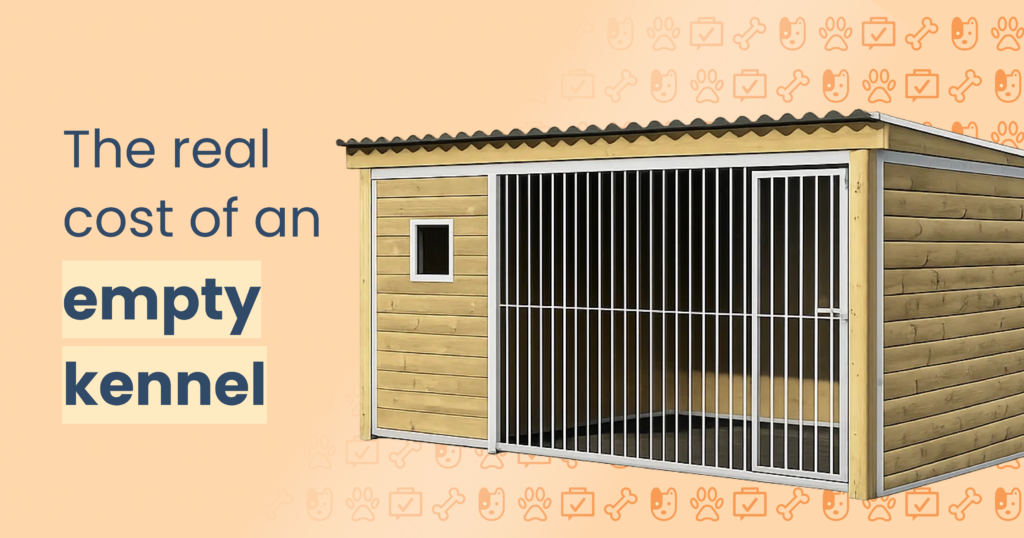
Occupancy math is simple to describe and easy to ignore: your rent, utilities, and base staffing cost the same whether you’re running at 40% capacity or 90%. Every open kennel run, empty daycare spot, or unbooked training slot on a given day is space you’re already paying for and not collecting revenue on. Understanding what your occupancy rate actually means, and what to do about the gap, is one of the fastest paths to more predictable income without adding a single new service.
We dived into this topic in our recent webinar, No Ruff Days: Hitting the 60% Occupancy Mark!
What the Industry Data Shows
The 2026 Pet Boarding, Daycare, and Resort Industry Benchmarking Report surveyed 457 pet-service business owners, and the occupancy gap between top performers and everyone else is one of the starkest findings in the entire study.
- Boarding: 52% of $1M+ operators achieve 60%+ occupancy, compared to just 29% of businesses under $150K in revenue.
- Daycare: The gap is even wider here. 53% of $1M+ operators hit 60%+ daycare occupancy versus only 18% of sub-$150K operators, making daycare one of the most accessible, lowest-cost paths to closing the gap for operators with open daytime capacity.
- Grooming: 49% of $1M+ operators run at 60%+ occupancy versus 10% of the smallest operators.
- Overall, 40% of businesses in the report’s “Emerging” tier (under $150K in revenue) report sub-30% boarding occupancy, meaning a meaningful share of the industry is sitting on unused capacity every single week.
The takeaway isn’t that smaller operators are doing something wrong. It’s that occupancy is a measurable, improvable lever, one that top performers treat as a weekly metric rather than a background feeling of “we’re pretty busy.”
Why Crossing 60% Changes Everything
The benchmarking data doesn’t say to aim for 100% occupancy. It says something more specific: crossing the 60% occupancy threshold is what separates the businesses earning $1M+ from everyone else. Below that line, empty capacity is quietly eating into margin every day. Above it, the math starts working in your favor, since your fixed costs, rent, base staffing, utilities, are already covered, and every additional booked slot drops closer to pure profit.
That’s why 60%+ occupancy isn’t a nice-to-have. It’s the point where a pet business stops absorbing hidden costs and starts compounding revenue.
Advice from the Pros: Managing High-Demand Days vs. Slower Stretches
We asked PocketSuite pet pros how they balance high-demand days, like holidays, against slower mid-week stretches. Their answers point to two very different, equally valid strategies.

Georgette Lombardo, Pawsitive Training ABQ
“My pricing doesn’t change. When demand is higher, I have three employees and myself. It’s rare for someone who wants to work with us to have to wait more than one week. I’ve tried promotions for existing clients in the past, and they fell flat.”
Georgette’s team holds pricing steady year-round and instead manages demand through staffing and wait-time expectations. For a service built on trust and consistency, a stable rate card reinforces the relationship rather than signaling a sale.

Heather Chanelle Mazahri, Z Dog Training Academy
“We will occasionally run promotions, but the most important thing is to allow your team to have the knowledge of what price points they can negotiate with.”
Heather’s approach gives her team flexibility within a defined range, letting staff respond to a slower week without a blanket discount policy. Both approaches solve the same underlying occupancy question. Neither relies on guesswork.
What the Dog Training Data Shows
Occupancy math applies just as directly to training as it does to boarding runs, and the 2026 Dog Training Benchmarking Study puts real numbers behind it.
- Board and Train capacity tracks closely with revenue. 53% of $150K+ trainers run their Board and Train program at 60%+ utilization, compared to just 15% of trainers earning under $50K.
- Utilization matters more than volume. A trainer seeing 15 dogs a week at 90% capacity is in a healthier position than one seeing the same 15 dogs at 40% capacity, because the second trainer has open schedule that could be filled with additional revenue.
- Booking lead time is a health signal, not just a scheduling detail. Among trainers who report being unhappy with their income, 21% say they’re not typically fully booked. Among $150K+ trainers, only 2% say the same, and 54% of happy trainers are booked out a month or more.
- $50K to $149K trainers are already maxing out private training, with 55% at 60%+ utilization, the highest of any revenue tier, a strong signal that it may be time to add a second service line or team member rather than more private sessions.
The pattern holds across every service line: the businesses with the steadiest income aren’t necessarily the ones seeing the most dogs. They’re the ones who know their utilization number and treat a full booking calendar as something to protect on purpose.
Turning Occupancy Into a Weekly Habit
You don’t need a data science degree to close the gap the benchmarking data reveals. You need a number to check every week and a short list of levers to pull when it’s low:
- Check your occupancy rate by service line (boarding, daycare, grooming, training) weekly, not just at month’s end
- If daycare capacity is open on weekdays, that’s typically your fastest, lowest-cost fill given how much smaller a lift it is than adding boarding runs
- Use waitlists during predictable peak periods (holidays, long weekends) so you can fill last-minute cancellations instantly instead of losing that revenue
- Watch for structural gaps, like one weekday that’s consistently soft, and address it directly with a standing offer for that day rather than a sitewide discount
How PocketSuite Helps You See the Gap
You can’t manage what you can’t see, and this is exactly where most pet businesses lose the thread. Set up your kennels, runs, and grooming tables as Resources, and group identical ones (say, 20 standard kennels) into a Resource Group, so PocketSuite can automatically assign any available one to a new booking and pack your schedule tightly instead of leaving capacity scattered. The Resource Calendar’s built-in Occupancy report then tracks your facility’s real occupancy rate based on overnight reservations, turning the 60%+ benchmark from a guess into a number you check the same way you’d check your bank balance. Smart Reports (Income Reports) layer on revenue and utilization by kennel, suite, or run, and the Check-In Workflow takes each stay from digital intake to contactless checkout, so a fuller calendar doesn’t mean more paperwork for your team. Add appointment buffers to protect turnaround time between bookings, and use packages or subscriptions to lock in repeat business that keeps your weekday occupancy steady even when new-client volume slows.
Occupancy math isn’t about running harder. It’s about seeing clearly what you’ve already built, and filling it.