




Icons is a PocketSuite feature that lets you tag clients, bookings, and other records with small visual symbols that surface critical information at a glance. Instead of digging through client notes mid-appointment or during a busy check-in, your team sees the details that matter most right where they’re already looking: your calendar, your client list, and each individual record.
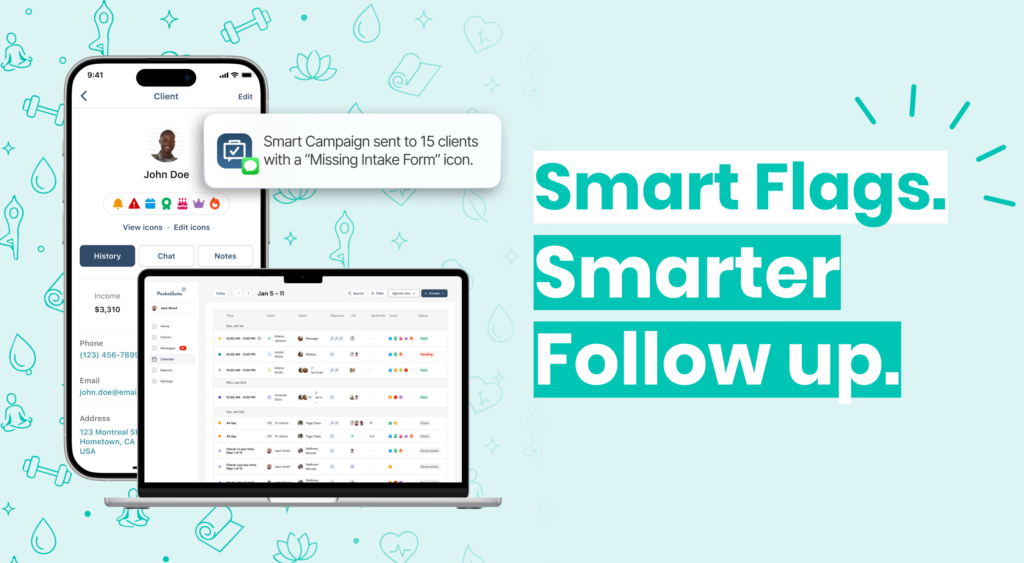
Each icon has three parts: the symbol and color you choose, the record it applies to (a client, a booking, a sub-account, and more), and an optional trigger that applies it automatically when a condition is met. A client whose vaccine record has expired, a booking with an unsigned waiver, a first-time visitor who hasn’t completed intake: Icons surfaces all of it without anyone having to remember to check.
Plus, PocketSuite’s automated text marketing feature, Smart Campaigns, then uses those tags to automatically send the right message to the right client at the right time. Together, they turn your client list into a hands-free marketing engine.
Before you dive in: The examples in this guide are meant to spark ideas, not prescribe a one-size-fits-all setup. A few things worth knowing as you build your icon strategy:
- Custom fields come first. Many of the triggers described here require a custom field to exist in Settings > Client Fields. If the field doesn’t exist yet, the trigger won’t fire.
- Triggered icons are automatic. Manual icons are manual. These are two separate modes in PocketSuite and they’re mutually exclusive. An icon with a trigger cannot be applied by hand, and an icon without a trigger can only be applied by hand.
- Icons and Smart Campaigns work together, but separately. Icons flag the client. The campaign sends the message. Setting up an icon doesn’t automatically activate a campaign — each needs to be configured on its own.
- Too busy to set up on your own? Our Client Automation Pack pairs you with a PocketSuite specialist who builds your icons and campaigns from scratch, tailored to your business.
Icons aren’t just a safety tool. Used across the full client lifecycle, they help you convert more leads, deliver better care, keep your best clients coming back, and re-engage the ones who’ve gone quiet.
Here’s how to put them to work at every stage.
Stage 1: Lead
Qualify and Prepare Before the First Session
Before a wellness client ever walks into your studio, Icons can help your team track where a lead stands and flag anything missing before the first session is confirmed. Icons give you visibility on:
- New clients who completed your health intake form but haven’t made a first booking
- Referrals who were added to your system after a practitioner took a phone inquiry
- Prospective clients who reached out while you were in session and never received a reply
By the time a client arrives for their first session, your team already knows who they are, how they found you, and what still needs to happen before the visit is confirmed.
Tag, Trigger, Book: Using Icons and Smart Campaigns to Convert Clients
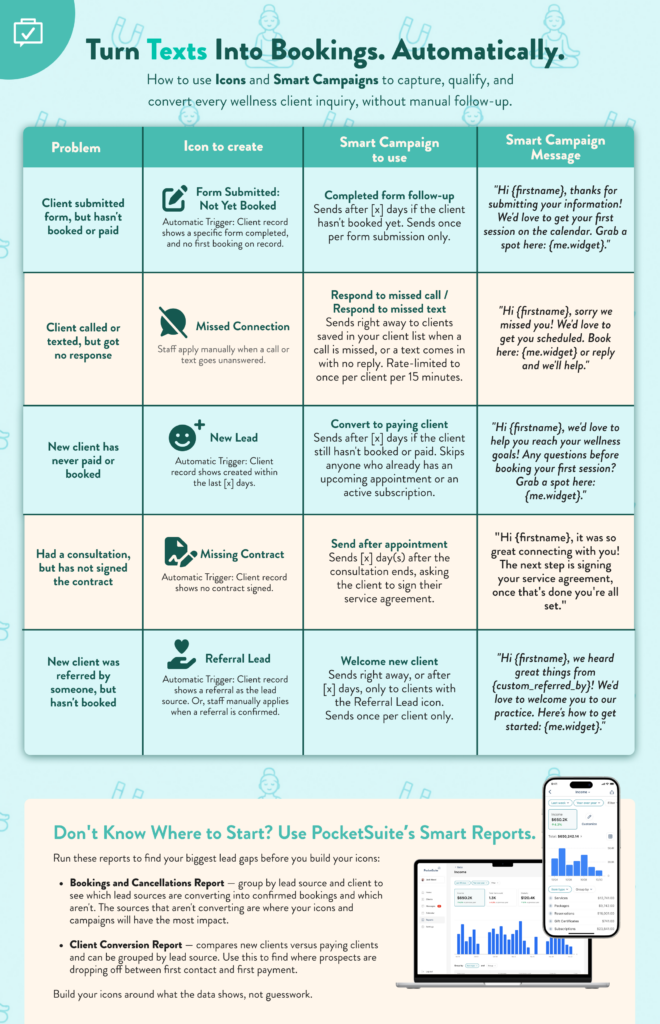

A prospective client who reaches out and doesn’t hear back won’t wait long to find another practitioner. Icons flag the moment a lead stalls, and Smart Campaigns follows up automatically so your schedule fills without manual outreach. Read this list of Icons and Smart campaigns that you can create at the lead stage (or download the guide above!):
- Form Submitted: Not Yet Booked — When a prospective client submits your health intake form but hasn’t made a first booking, this icon appears automatically on their client record. Pair it with the Completed Form Follow-Up Smart Campaign to send a timely message that gets their first session on the calendar.
- Missed Connection — When a call or text goes unanswered, staff apply this icon manually. It gates the Respond to Missed Call or Respond to Missed Text Smart Campaign, which fires immediately with your booking link so no inquiry goes cold while you’re in session.
- New Lead — When a new client is added to your system but hasn’t paid or booked, this icon fires automatically. The Convert to Paying Client Smart Campaign follows up after a set number of days, automatically skipping anyone who has since confirmed an appointment.
- Missing Contract — When a prospective client has had a consultation but hasn’t signed their service agreement, this icon flags the gap. The Send After Appointment Smart Campaign follows up automatically, prompting them to sign before the momentum from the consultation fades.
- Referral Lead — When a new client’s record shows a referral source, this icon fires automatically. It gates a warmer version of the Welcome New Client Smart Campaign so referred clients feel personally welcomed before their first session.
Plus, you can use PocketSuite’s Smart Reports to find your biggest lead gaps before you build your icons:
- Bookings and Cancellations Report — group by lead source and client to see which lead sources are converting into confirmed bookings and which aren’t. The sources that aren’t converting are where your icons and campaigns will have the most impact.
- Client Conversion Report — compares new clients versus paying clients and can be grouped by lead source. Use this to find where prospects are dropping off between first contact and first payment.
Build your icons around what the data shows, not guesswork.
Stage 2: New Client
Start Every Relationship with the Full Picture
New clients often underreport on intake forms. Icons built on your intake fields give practitioners a quick visual prompt to probe further, ask the right questions, and adjust the session before it starts.
- First-time client: First booking trigger. Allocate extra time for intake review, rapport building, and a thorough pre-session check-in.
- Intake form incomplete: Intake form field is empty. Non-negotiable before any hands-on or clinical service. Front desk flags before the client is seated.
- Chronic condition flagged: “Medical history” multi-select includes specific conditions. Practitioner tailors session approach from the start rather than discovering it mid-treatment.
- Contraindication on file: “Contraindications” custom field is not empty. Review before any bodywork or treatment, every visit, not just the first.
- Current medications on file: “Current medications” is not empty. Critical for practitioners offering nutritional, herbal, or supplemental protocols alongside their primary service.
Stage 3a: Arrival
Use the Moments Before the Session Starts
In wellness, arrival is informal, but it’s not insignificant. The brief window between when a client walks in and when they get on the table is when your practitioner can confirm critical details, adjust room setup, and set the tone for the entire session. Icons make that preparation invisible to the client and effortless for your team.
- Room setup flag: Applied based on intake details like trimester, injury location, or mobility limitations. Alerts the practitioner to adjust the table, bolsters, or equipment before the client enters the room. Nothing disrupts the experience faster than setting up the room in front of the client.
- Intake update needed: Applied when a client’s last intake was completed more than six months ago or when a gap between visits suggests their health status may have changed. Prompts a brief verbal check-in at arrival rather than relying on outdated information mid-session.
- Upsell opportunity: Applied based on intake responses or prior session notes. A client whose intake flagged chronic tension in the neck and shoulders is a natural candidate for a hot stone add-on or an extended session upgrade. Tag it before arrival so the practitioner can make the offer as part of the pre-session conversation, not as an awkward mid-session interruption.
- Anxious or first-time client: First booking trigger or intake flag. Prompts the practitioner to take extra time explaining the process, check in more frequently during the session, and create a slower, more reassuring experience from the moment the client arrives.
Stage 3b: In Session
Protect Every Session You Deliver
For massage therapists, personal trainers, acupuncturists, and other hands-on practitioners, in-session icons are the most safety-critical flags in your entire system. These belong at the top of your priority list.
- DVT or blood clot history: “DVT history” is “Yes.” Absolute contraindication for deep tissue work. This icon should never be buried below administrative flags.
- Trimester on file: “Trimester” single-select is not empty. Triggers prenatal protocol: side-lying positioning, bolster setup, avoidance of specific pressure points and essential oils.
- Recent surgery or injury: “Recent surgery/injury” field is not empty. Flags areas to avoid and prompts a pre-session check-in before any bodywork begins.
- Pressure preference noted: “Preferred pressure” is not empty. Practitioner adjusts before entering the room. No mid-session corrections, no guesswork.
- Focus area requested: “Problem area” multi-select is not empty. Review before the session so time isn’t spent on the wrong areas.
- Topical product restriction: “Product sensitivities” is not empty. Therapist or technician pulls the right products before setup, not mid-service.
- Supplement interaction flag: “Supplement use” field is not empty. Relevant for practitioners offering functional wellness or nutrition alongside their primary modality.
- SOAP notes incomplete: “Session notes” field is empty after a visit. Reminds practitioners to document before the next session so nothing is lost between appointments.
Stage 3c: Checkout
Close Every Session With a Path Forward
In wellness, checkout is a clinical and relational moment in equal measure. The client is relaxed, receptive, and more open to a meaningful conversation than at almost any other point in their day. Icons help your team use that window intentionally, whether that means a package renewal, a product recommendation, a referral ask, or simply a well-timed rebooking prompt.
- Package on last session: Triggered when a client’s package reaches its final booking. Prompts the practitioner or front desk to initiate a renewal conversation at checkout while the session’s value is still fresh. The best time to resell a package is when the client just experienced exactly what they’re buying.
- Product or supplement recommendation: Applied manually when a practitioner identifies a product, supplement, or tool that would extend the benefit of the session between visits. A client dealing with chronic lower back tension might benefit from a foam roller or a topical magnesium recommendation. Surface the conversation at checkout when the practitioner’s credibility is highest.
- Rebook prompt: Applied based on session cadence or practitioner recommendation. Clients on a regular maintenance schedule, weekly, biweekly, or monthly, should be rebooked before they leave. An icon ensures the front desk makes the offer every time, not just when someone remembers.
- Follow-up session recommended: Applied manually post-session when the practitioner identifies something that warrants a follow-up, a new injury, a technique that needs reinforcing, or a concern that needs monitoring. Plant the seed at checkout while the client is present and engaged.
- Referral ask: Applied manually to clients who had a strong session or who have expressed satisfaction. The moment a client is walking out the door feeling great is the best moment to ask if they know anyone who could benefit from the same thing.
Stage 4: Nurture
Build Relationships That Turn Clients Into Regulars
Retention in health and wellness is built on trust and consistency. Icons help you remember what matters to each client and give your team the context to deliver a personal experience every time.
- VIP client: Applied manually to long-term regulars, high-value accounts, or clients who consistently refer. Prompts elevated attention and opens the door to exclusive outreach.
- Assigned practitioner noted: Record assigned to a specific team member. Protects the practitioner-client relationship in multi-provider practices and prevents accidental re-assignment.
- Package expiring: Package expiration date is approaching. Prompts a rebooking conversation before the client lapses, ideally during the current session.
- Birthday: “Client birthday” date field trigger fires in the days leading up to the client’s birthday. A simple personalized message, or a complimentary add-on offer, reinforces that the relationship is about more than transactions. In wellness especially, clients return to practitioners they feel genuinely cared for by.
- Client anniversary: Triggered on the anniversary of the client’s first booking. Acknowledges the length of the relationship and gives your team a warm, genuine reason to reach out between sessions. A “We’ve been working together for a year this month” message lands very differently than a promotional text.
Stage 5: Lapsed
Re-Engage Clients Before the Window Closes
In wellness, a client who skips a few appointments often isn’t choosing a competitor. They’re busy, distracted, or waiting for someone to remind them why they came in the first place. Icons help you identify them. Smart Campaigns helps you reach them.
- Follow-up recommended: Applied manually post-session when a practitioner identifies a client who would benefit from continuing care. A lapsed client with this icon is a warm outreach target.
- Intake form incomplete: Reapplied when forms are outdated or a significant gap has passed. Returning clients with old intakes need a fresh review.
Stage 6: Comeback
Re-Onboard Returning Clients Safely
A client who returns after a long gap needs a fresh intake conversation. Health changes, medications change, injuries heal or worsen. Icons make the re-onboarding feel seamless rather than procedural.
- Contraindication on file: Review and confirm on return. A lot can change in six months.
- Current medications on file: Reconfirm on return. New prescriptions, supplements, or treatments may have started during the absence.
- Recent surgery or injury: Check on return. The injury that was active when they last visited may now be recovering, healed, or replaced by something new.
- Physician clearance required: Reapply if significant time has passed or a new condition is disclosed. Returning clients sometimes disclose more than new clients do.
See Icons in Action
Want to see how it all comes together before you dive in? We hosted a live walkthrough of the Icons feature, covering real setup examples, trigger logic, and use cases across different service types. Watch the recording to see exactly how other pros are building their icon strategy, and get a head start on your own.
Ready to put it all together?
Icons and Smart Campaigns are two of the most powerful tools in PocketSuite, and they’re even better when they work together. The icons organize your clients. The campaigns reach them. And once it’s set up, the whole system runs in the background while you focus on your work. If you want help getting it right from day one, our Client Automation Pack pairs you with a dedicated PocketSuite specialist who builds your Icons and Smart Campaigns from scratch, tailored to your business. No blank screens, no guesswork, no adding another project to your plate.
Not on PocketSuite yet? Start your 30-Day FREE Trial today!